
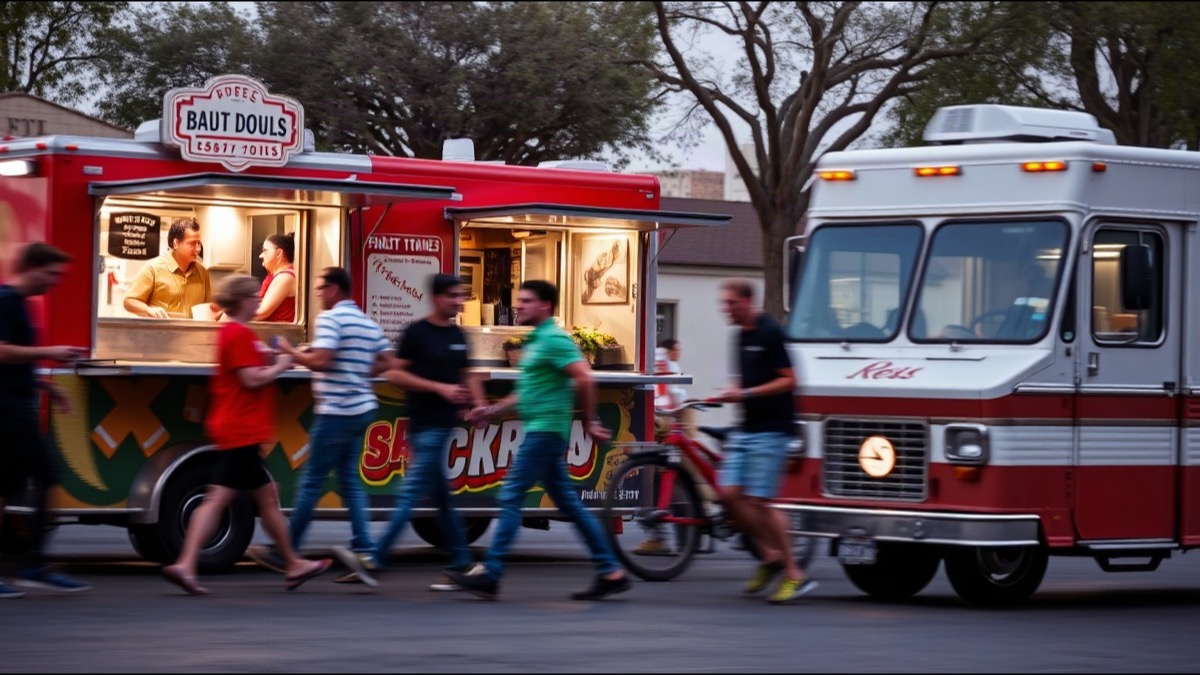
A food truck in Stockton needs commercial auto on the vehicle, general liability insurance before San Joaquin County Environmental Health will issue a mobile food facility permit, workers’ compensation from the first hire, and equipment breakdown coverage for the kitchen installed inside the truck — all in place before the first service, not after the first loss. Here is what each coverage does for a food truck operating in Stockton and what you can expect it to cost.
Stockton’s food truck scene has grown substantially alongside its Friday Night Markets on the downtown waterfront, the weekly events at Banner Island and Weber Point, the construction and warehouse corridors along I-5 and the Port of Stockton where lunch-hour foot traffic drives consistent daily revenue, and the expanding calendar of festivals and community events across San Joaquin County. Food trucks are simultaneously a vehicle business, a food service business, and a retail business — and each of those dimensions carries a distinct insurance exposure that a single personal auto policy or homeowner’s endorsement does not address. According to the U.S. Bureau of Labor Statistics, food service workers face one of the highest rates of nonfatal occupational injury of any private sector, with burns, lacerations, and heat-related illness among the leading causes. Insurance City’s parent operation serves 4,500+ active customers across three California offices and wrote 2,080 new policies in 2025. We work with mobile food operators throughout San Joaquin County and understand the specific combination of coverages the County health department, the City of Stockton, and event venues actually require before a food truck can legally operate in this market.
The core coverages every Stockton food truck needs
Commercial auto — required before the truck moves
The single most critical and most commonly misunderstood coverage for a food truck owner is commercial auto. A personal auto policy contains a business-use exclusion: the carrier can deny a claim entirely if the vehicle was operating commercially at the time of the loss. Because a food truck is a commercial vehicle by definition — it operates under a business license, earns commercial income, may carry employees, and is operated at commercial locations — a personal auto policy provides no protection once the truck is on the road for business purposes.
Commercial auto covers the vehicle for bodily injury and property damage liability, and physical damage to the truck itself under commercial use conditions. For food trucks specifically, the coverage question that catches most owners off guard is what happens to the cooking equipment and inventory inside the truck during transit. Generators, commercial flat tops, fryers, refrigeration units, and prep equipment represent tens of thousands of dollars in installed equipment that may not be covered under a standard commercial auto physical damage provision. Ask your broker explicitly: is the kitchen equipment covered while the truck is in motion, and if not, does an inland marine or equipment breakdown endorsement need to be added?
The truck is not just your transportation — it is your entire place of business, and losing it to an accident or fire without the right commercial coverage can end the business permanently.
General liability — required before any permit is issued
San Joaquin County Environmental Health requires proof of general liability insurance as part of the mobile food facility permit application. The City of Stockton requires it for a business license and for access to most private event venues, farmers markets, and commercial property locations. A general liability policy covers third-party bodily injury and property damage arising from your food truck operations: a customer who burns a hand reaching toward the service window, a guest who slips on a wet mat near your station at a community event, a bystander injured when your equipment is moved during setup or breakdown, or a product liability claim alleging that food you served caused a food-borne illness.
Standard limits for food trucks start at $1 million per occurrence and $2 million aggregate. Most Stockton event organizers, farmers market operators, and property owners where food trucks park require a certificate of insurance naming them as an additional insured before you can operate on their premises. Your broker needs to generate those certificates quickly — the request will come the day before an event, and a delayed certificate means you do not work that day.
General liability does not cover your employees’ on-the-job injuries (that is workers’ compensation), your vehicle or kitchen equipment (that is commercial auto and equipment breakdown), or your business income if a covered event shuts the truck down. Each requires a separate policy or rider.
Workers’ compensation — mandatory from the first hire
Under California Labor Code §3700, workers’ compensation is mandatory from the moment you hire your first employee — no minimum headcount, no grace period, and no exemption for a prep cook who works only on weekends or a cashier hired for a single event. Food truck work is physically hazardous in ways specific to the environment: burns from open-flame burners, flat tops, and deep fryers in tight working quarters with no escape route; cuts from high-volume knife prep; slips in confined spaces that can become wet during service; and heat-related illness from working inside a metal vehicle during Stockton summers when ambient temperatures regularly exceed 100 degrees Fahrenheit and interior truck temperatures can climb significantly higher.
A food truck owner operating without workers’ comp is personally liable for all on-the-job medical bills, lost wages, and disability payments from the first employee’s first day. California law also imposes civil penalties for operating without coverage and creates potential criminal liability. Workers’ comp premiums are calculated on audited annual payroll — if your employee count grows during the season, request a mid-year payroll adjustment to avoid a large audit reconciliation at year-end.
Equipment breakdown coverage
Commercial auto and general liability do not cover the mechanical breakdown of the kitchen equipment installed in your truck. A generator failure that takes the refrigeration offline and spoils a day’s inventory, a fryer malfunction that forces a cancellation of a catered event, or a compressor failure on a refrigeration unit during a Stockton summer all represent direct financial losses that fall outside the standard commercial auto and GL structure. Equipment breakdown coverage — sometimes called boiler and machinery coverage — fills this gap by covering the repair or replacement costs when commercial kitchen equipment fails due to mechanical or electrical breakdown.
For a food truck where every piece of cooking equipment is essential to operating revenue, a single equipment failure during a high-revenue event weekend can generate losses that exceed a year’s premium on an equipment breakdown policy. Discuss this coverage with your broker when you review the commercial auto and GL structure — it is often available as an endorsement rather than a separate standalone policy.
What food truck insurance costs in Stockton
Rates depend on the value of your truck and installed kitchen equipment, your annual revenue, the number of employees, your personal and employee driving records, the types of events and locations you operate at, your commissary arrangement, and your claims history. As working ranges for Stockton-area food trucks:
- Commercial auto: $2,500–$6,000 per year depending on vehicle value, use type, and driver records; trucks with higher equipment values or multiple employed drivers will be higher in this range
- General liability: $1,200–$3,500 per year for most food truck operations; operations with catering contracts, alcohol service, or high-volume event schedules may see higher program costs
- Workers’ compensation: Calculated on audited payroll; food preparation and service classifications vary by specific role. A small operation with one part-time employee might see annual workers’ comp under $2,000; a truck with two or three full-time workers will be proportionally higher
- Equipment breakdown: Varies by the replacement value of installed kitchen equipment; generally $300–$800 per year as a standalone endorsement for a food truck kitchen
These are working ranges, not quotes. Your actual premium depends on the specifics of your operation and the commercial carriers our agents access for your account. No broker fees on standard policies.
Why a local independent broker matters for Stockton food trucks
A national call center does not understand that San Joaquin County Environmental Health requires a specific GL limit before issuing a mobile food facility permit, that a commissary kitchen agreement is a condition of that permit and creates a separate liability exposure, that the equipment inside the truck is a distinct insurable interest from the vehicle itself, or that Stockton’s event calendar creates concentrated revenue periods where a single uninsured equipment failure is a serious business loss. An independent broker who works with mobile food operators understands how to structure commercial auto, GL, and equipment breakdown together efficiently, which commercial carriers in our network have appetite for food truck accounts in San Joaquin County, and how to generate landlord and event-organizer certificates without a process delay that costs you a spot at a market or event.
Insurance City is located in Stockton at 956 W. Robinhood Drive — call (209) 670-1556 to speak with an agent about your food truck coverage. Most commercial policies are quoted and bound without an office visit. No broker fees on standard policies.
Frequently asked questions
Does a food truck in Stockton need general liability insurance?
Yes, and it is a permit requirement. San Joaquin County Environmental Health requires proof of general liability as part of the mobile food facility permit application process, and the City of Stockton requires it for a business license and for access to most event venues. GL covers third-party bodily injury and property damage from your food truck operations, including product liability for a food-borne illness claim. Standard limits start at $1 million per occurrence and $2 million aggregate. Event organizers and property owners throughout Stockton and San Joaquin County typically require a certificate of insurance naming them as an additional insured before a food truck can operate on their premises — your broker needs to generate those certificates on short notice.
Is commercial auto the same as personal auto for a food truck?
No. Personal auto policies contain a commercial-use exclusion: if your food truck is involved in an accident while operating commercially, the carrier can deny the claim entirely. Because a food truck earns commercial income, operates under a business license, and may carry employees, a personal auto policy provides no protection once the truck is on the road for business. A commercial auto policy covers the truck for liability and physical damage under commercial use, and should be structured to include the kitchen equipment inside the truck while in transit. Confirm with your broker whether equipment-in-transit is part of the commercial auto coverage or whether a separate inland marine endorsement is needed.
When does workers’ compensation become required for a food truck in California?
Under California Labor Code §3700, workers’ compensation is mandatory from the first employee, with no minimum headcount and no exemption for part-time or event-day-only workers. Food truck work is hazardous: burns, cuts, slips in confined spaces, and heat-related illness are real occupational risks in a Stockton summer operating environment. A food truck owner without workers’ comp is personally liable for all medical costs, lost wages, and disability from the first employee’s first shift, plus civil penalties and potential criminal liability under California law.
How much does food truck insurance cost in Stockton?
As working ranges for Stockton-area food trucks: commercial auto typically runs $2,500 to $6,000 per year; general liability runs $1,200 to $3,500 per year; workers’ comp is calculated on audited payroll; equipment breakdown coverage is generally $300 to $800 per year for installed kitchen equipment. These are ranges, not quotes. Your actual premium depends on truck value, installed equipment, driver records, employee count, annual revenue, and the events and locations you operate at. Most food truck owners in Stockton need at minimum commercial auto and GL before a single permit is approved or a single event spot is confirmed.
Related reading: Box Truck Delivery Insurance in Stockton, CA — Food Truck Insurance in Ceres, CA — Restaurant and Taqueria Insurance in Stockton, CA — Lee esta guía en español
Insurance City Agency — 956 W. Robinhood Drive, Stockton, CA 95207 — (209) 670-1556. Serving Stockton food truck operators directly from our Stockton office. CA License #6003045. Reviewed by Santo Militello, California-licensed agent and owner (CA Lic. #1737723). Our licensed team brings more than 70 years of combined insurance experience.
Ready for a quote? Call, walk in, or send the form
Call (209) 670-1556 Request a Quote
956 W Robinhood Dr, Stockton · Mon–Fri 10am–6pm · Walk-ins welcome · Se habla español · ITIN accepted. Insurance City Agency, LLC · CA License #6003045.