
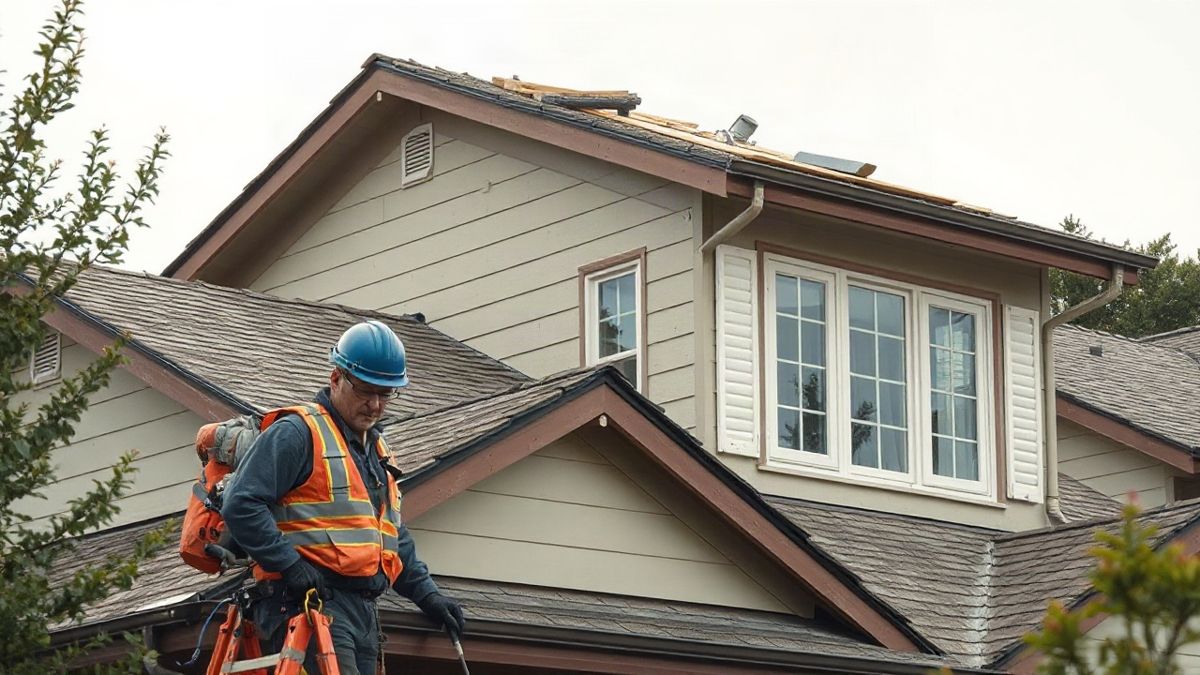
Answer: California C-39 roofing contractor insurance almost always means general liability placed in the Excess & Surplus (E&S) market (admitted carriers usually decline or exclude roofing), a $25,000 CSLB contractor license bond under Business & Professions Code §7071.6, workers’ compensation under Labor Code §3700 when you have employees (NCCI class 5551 for roofing), and commercial auto for job-site vehicles.
Get a quote in minutes
What happens next: a licensed agent compares several carriers for you and calls you back with your options. No broker fees on standard policies (Stockton & San Jose offices).
Standard admitted GL markets decline most C-39 roofers because of fall severity and water-intrusion claims. E&S placement through a licensed surplus lines broker is the normal path — not a red flag. CSLB still requires the $25k bond; WC is mandatory from the first employee. Call (209) 670-1556. Insurance City Agency, LLC — CA License #6003045. Stockton 956 W Robinhood Dr; San Jose 25 N 14th St Ste 125. No broker fees on standard policies (Stockton & San Jose offices).
Insurance City’s parent operation serves 4,500+ active customers and wrote 2,080 new policies in 2025. Quoting a C-39 like a painter gets you declined or underinsured.
Why do standard insurance carriers decline roofing contractors?
Standard admitted GL carriers apply actuarial pricing based on historical loss data. Roofing ranks consistently among the top three trades for both frequency and severity of claims for two reasons:
- Fall-from-height risk: OSHA data consistently identifies falls as the leading cause of construction fatalities and serious injury. Roofing work above the first story is classified in the highest-hazard tier for workers comp and GL underwriting.
- Consequential property damage: A failed roof membrane, a missed nail line, or improper flashing can allow water intrusion that destroys wall assemblies, flooring, and personal property — claims that can run $50,000 to $500,000 on a single residence. This severity profile causes admitted carriers to either exclude roofing or add roofing exclusion endorsements to their standard contractor GL forms.
The practical result: most C-39 roofing contractors cannot buy GL insurance in the admitted (standard) market and must be placed in the Excess and Surplus (E&S) market through a licensed surplus lines broker.
Being placed in E&S is not a deficiency — it is the standard placement path for roofing in California.
What is E&S market placement and what does it mean for your policy?
The Excess and Surplus (E&S) market consists of non-admitted insurers — carriers that are not required to file their rates with the California Department of Insurance. They accept risks that admitted markets decline. For a C-39 roofer, E&S placement means:
- The policy is legal and enforceable in California. A surplus lines policy placed by a licensed California surplus lines broker is a valid insurance contract.
- The carrier is not backed by the California Insurance Guarantee Association (CIGA) in the event of insurer insolvency. In practice, E&S carriers used for contractor GL (E&S, and specialty programs) are financially sound — but the CIGA backstop does not apply.
- The policy form is typically broader than admitted forms — E&S carriers can offer coverage structures admitted markets cannot. Most contractor GL policies in the E&S market are occurrence-form, which is appropriate for roofing.
- A California surplus lines tax (3% of premium) applies and is paid by the policyholder. This is standard and legal under Insurance Code §1760 et seq.
What does a compliant C-39 roofing insurance package include?
A complete insurance package for a licensed C-39 contractor in California includes:
- General Liability (GL) — E&S market: Minimum $1M per occurrence / $2M aggregate. General contractors you work for as a subcontractor will require this on your certificate of insurance. Some commercial GC contracts require $2M per occurrence — confirm before bidding. Roofing GL is priced on gross receipts or subcontracted cost, not payroll.
- Workers Compensation: Mandatory under California Labor Code §3700 from the first employee. Roofing workers are classified under NCCI class code 5551 (roofing — all types + drivers), which carries one of the highest base rates in the CSLB trades. The WC rate for roofers reflects the elevated fall-injury history of the class.
- CSLB Contractor License Bond ($25,000): Required by Business and Professions Code §7071.6 for all CSLB-licensed contractors. The bond must remain active to maintain license status. This is a surety bond, not insurance — it protects consumers against contractor default, not the contractor against liability claims.
- Commercial Auto (if applicable): Any vehicle driven to job sites, even your personal truck, should be on a commercial auto policy when used for business purposes. A personal auto policy excludes business use and will deny claims arising from driving to and from job sites.
What factors drive the cost of roofing contractor GL in California?
E&S carriers price roofing GL on a set of underwriting factors that can move the annual premium significantly in either direction:
- Gross receipts or subcontracted cost: The primary rating base. A roofer doing $500,000 in annual revenue pays more than one doing $200,000. Subcontracted-out work is rated separately — uninsured subcontractor cost is charged at a higher rate than your own payroll.
- Roofing material type: Composition shingle on residential is the most favorable. Flat/low-slope work (modified bitumen, TPO, EPDM) adds complexity. Torch-down applications (open-flame heat) trigger the highest rate class for most E&S carriers. Metal roofing falls between these tiers.
- Number of stories: Most E&S carriers will not write roofing above three stories without a specialty program. Work height is one of the first questions on the GL application.
- Claims history: A GL claim in the prior three years, especially a water-intrusion or workmanship claim, can result in surcharge, declination, or significantly higher retentions.
- Subcontractor certificates: If you use uninsured subcontractors, their payroll is charged back to you in a GL audit at the uninsured sub rate. Requiring certificates from every sub protects you from audit surprises.
We do not invent a statewide GL premium band for C-39. E&S carriers price $1M/$2M limits from the factors above (receipts, materials, height, claims, uninsured-sub exposure). Call (209) 670-1556 with your gross receipts estimate, material types, and subcontractor certificate program ready — Insurance City Agency, LLC (CA License #6003045) places the comparison without quoting fake averages.
Insurance City's parent operation serves 4,500+ active customers across three California offices and wrote 2,080 new policies in 2025. We place C-39 roofing contractors in E&S markets and can package the GL, workers comp, and CSLB bond in a single application process. Call (209) 670-1556 with your gross receipts estimate, roofing material types, and subcontractor certificate program (or lack of one) ready.
Roofing workers’ compensation in California (class 5551)
Answer: Roofing employees are typically classified under NCCI class code 5551 (roofing — all types + drivers). California Labor Code §3700 requires workers’ compensation from the first employee. Premium is payroll × class rate × experience modifier — we do not invent a single statewide “rate” here because WCIRB/advisory rates and your modifier change the number. What buyers searching “roofing workers comp rates california” need first is the class, the mandate, and how uninsured subs can land on your audit.
- Mandatory from employee #1 under Labor Code §3700 — no “wait until three employees” myth for roofing crews.
- Class 5551 sits among the higher construction classes because falls drive frequency and severity (OSHA consistently ranks falls among leading construction fatality causes).
- Owner-only exemption: A sole owner-operator with no employees may file a WC exemption, but many general contractors still require a WC certificate before you sub — verify the contract before bidding.
- Uninsured subcontractors: If a roofing sub you hire has no WC and is injured on your job, medical and indemnity costs can be charged back to your policy at audit.
- What to bring for a WC quote: payroll by class, owner duties, prior loss runs, and whether any labor is 1099 vs W-2 (misclassification is an audit risk).
Attributed references: California Labor Code §3700; CSLB workers’ compensation filing rules for active licenses; OSHA construction fall-hazard guidance. For exemption questions see our workers’ comp exemption for California contractors guide — roofing rarely qualifies once you hire help.
What does CSLB require to maintain a C-39 roofing license?
The Contractors State License Board (CSLB) requires the following to hold an active C-39 license:
- A $25,000 contractor license bond filed with CSLB under Business and Professions Code §7071.6, maintained continuously
- Workers compensation insurance on file with CSLB for any employees, or a Certificate of Exemption (DE 542) if operating without employees
- The qualifying individual (QI) must maintain continuing education and meet examination requirements as CSLB specifies
CSLB enforces license suspension for lapsed bonds or missing WC filings. A suspended license means you cannot legally enter into new contracts. Neither we nor any broker can guarantee CSLB processing timelines — our role is to provide the bond and WC documents; the licensing status is controlled by CSLB.
Frequently Asked Questions
Why do standard carriers decline roofing contractors for GL?
Roofing is a high-hazard class because of fall-from-height injury risk and the high severity of water-intrusion property claims. Most standard admitted GL carriers apply a roofing exclusion or decline the class. C-39 contractors are typically placed in the E&S market — this is normal and does not mean you cannot get insured.
How much does GL insurance cost for a roofing contractor in California?
There is no honest single “average” we can publish. E&S markets rate $1M/$2M GL on gross receipts, material type (shingle vs. torch-down vs. flat), stories, and claims history. New ventures and accounts without a subcontractor certificate program usually price higher — get a quote on your numbers rather than a blog estimate.
What CSLB bond and insurance does a C-39 license require?
CSLB requires a $25,000 contractor license bond under Business and Professions Code §7071.6 and workers comp for any employees under Labor Code §3700. The bond protects consumers, not the contractor. GL is not required by CSLB but is required by virtually every general contractor you work for as a sub.
What workers’ compensation class applies to roofing employees in California?
Typically NCCI 5551. Labor Code §3700 mandates WC from employee #1. Premium = payroll × class rate × experience modifier — see WCIRB/CDI filings for advisory rates; we will not invent a blog “rate.” Bring payroll by class and loss runs when you call.
What is E&S market placement for roofing insurance?
E&S (Excess and Surplus) carriers are non-admitted insurers that accept risks standard markets decline. Roofing GL in California is almost always placed in E&S. The policy is legally valid, but the carrier is not backed by the California Insurance Guarantee Association (CIGA). For most roofers, E&S is the only GL option available.
Related reading:
- Lee esta guía en español: Aseguranza para techeros C-39 en California
- Cuánto cuesta el seguro para contratistas por oficio (ES)
- Workers Comp Exemption for California Contractors
- CSLB License Application Insurance and Bond Checklist
- Concrete & Masonry Contractor (C-8) Insurance in California — GL, Workers Comp, Commercial Auto, and Bond
- First Employee in California: Insurance Checklist
- Tow truck commercial auto (if you also run recovery units)
Insurance City Agency — 956 W. Robinhood Drive, Stockton, CA 95207 — (209) 670-1556. CA License #6003045. Reviewed by Santo Militello, California-licensed agent and owner (CA Lic. #1737723). Our licensed team brings more than 70 years of combined insurance experience. No broker fees on standard policies (Stockton & San Jose offices). Last reviewed 2026-09-22.
More guides from Insurance City
- Pressure Washing Business Insurance in Sacramento, CA: GL, Workers' Comp & Stormwater Rules
- How to Insure an Auto Detailing Business in California
- Vacant Rental Property Insurance in California: The 60-Day Rule
- Brewery and Taproom Insurance in California
- See all articles →
Insurance City in Stockton: Stockton auto insurance · homeowners insurance in Stockton · renters insurance · landlord insurance · life insurance in Stockton · business insurance in Stockton
Ready for a quote? Call, walk in, or send the form
Call (209) 670-1556 Request a Quote
956 W Robinhood Dr, Stockton · Mon–Fri 10am–6pm · Walk-ins welcome · Se habla español · ITIN accepted. Insurance City Agency, LLC · CA License #6003045.