
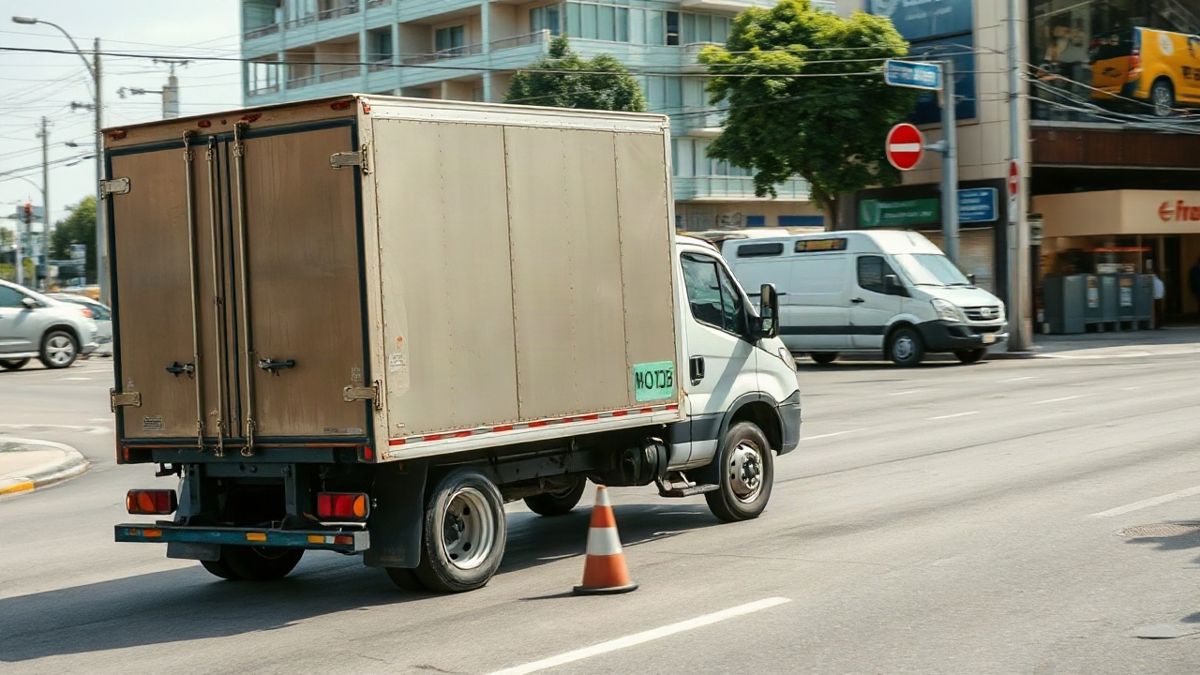
Whether a box truck under 26,000 lbs GVWR needs a DOT number in California depends entirely on one question: are you hauling for hire, and if so, are you crossing state lines? The answer determines whether you register with FMCSA, obtain a California Motor Carrier Permit (MCP), or neither. Getting this wrong doesn't just mean a fine — it can void your insurance coverage and put your load, your license, and your livelihood at risk.
Get a quote in minutes
What happens next: a licensed agent compares several carriers for you and calls you back with your options. No broker fees on standard policies (Stockton & San Jose offices).
This guide walks through the decision tree step by step and covers what insurance filings California and FMCSA actually require at this weight class.
Do you need a DOT number for a box truck under 26,000 lbs in California?
The short answer: it depends on how you use it, not just the weight.
- Interstate for-hire: You cross state lines to deliver freight for customers. A USDOT number and operating authority (MC number) are required under federal law (49 CFR Part 390), regardless of vehicle weight. A BMC-91 or BMC-91X filing and the MCS-90 endorsement attach to your policy.
- Intrastate for-hire in California: You haul commercially for customers but stay inside California. You do not need a federal DOT number at this weight. You do need a California Motor Carrier Permit (MCP) from the CA DMV. The MCP requires proof of insurance filed with the state before it is issued.
- Private carriage (not-for-hire): You use the truck for your own business purposes — moving your own goods, tools, or equipment for your own trade. You do not need a DOT number or MCP at this GVWR. You do still need commercial auto insurance, because a personal auto policy excludes business use.
The GVWR threshold for federal motor carrier registration rises to 10,001 lbs for vehicles transporting passengers or hazardous materials, and to 26,001 lbs for general freight carriers. A box truck at exactly 26,000 lbs GVWR falls under the general freight threshold for federal purposes.
Intrastate California: what the CA MCP permit actually requires
The California Motor Carrier Permit is the state's equivalent of federal operating authority for carriers that stay within California. Key requirements:
- Valid CA MCP issued by the DMV Motor Carrier Services section
- Proof of insurance on file with DMV before the permit is issued — the carrier submits an Insurance Identification Card (CA DMV form INF 1100 series) or an electronic filing via your insurer
- Minimum liability limits: $750,000 CSL for general freight under 10,001 lbs GVWR; same $750,000 CSL for 10,001–26,000 lbs GVWR non-hazardous freight carriers
- For carriers hauling household goods intrastate, higher limits apply under PUC regulations — verify with your agent
Neither we nor any broker can obtain, guarantee, or influence MCP decisions or processing timelines — our role is to place the coverage and submit the insurance evidence. The MCP application is submitted directly to the CA DMV.
Interstate for-hire: FMCSA filings for box trucks
If you cross state lines carrying freight for compensation, FMCSA requires:
- USDOT number: Required for all for-hire interstate motor carriers regardless of vehicle weight
- Operating authority (MC number): Required to carry regulated commodities for hire in interstate commerce
- BMC-91 or BMC-91X filing: Your insurer files evidence of your liability insurance directly with FMCSA. BMC-91 is the standard form; BMC-91X is for excess or umbrella policies stacked over a primary policy
- MCS-90 endorsement: Required by 49 CFR §387.15, this endorsement is attached to your primary commercial auto policy and makes the insurer responsible for final judgments even if a policy exclusion would otherwise apply — it is the backup layer that protects the public
- Minimum liability: $750,000 CSL for non-hazardous general freight under 49 CFR §387.9. Most freight brokers require $1,000,000 CSL on the COI, which is a commercial requirement, not a regulatory floor
The BMC-91 filing is the purchase trigger — FMCSA will not activate your operating authority until the filing clears.
Amazon Relay, delivery platforms, and broker-required filings
Amazon Relay and similar load-board or delivery-network platforms treat weight as secondary to regulatory status. To accept loads through a licensed freight broker, you typically need:
- An active USDOT number and MC number (operating authority in ACTIVE status, not pending)
- A current Certificate of Insurance (COI) naming the broker (Amazon Logistics, Relay carrier platform, or the specific broker MC) as an additional insured
- Minimum $1,000,000 auto liability — this is a broker commercial requirement, not a regulatory minimum, but refusing means you cannot book loads
- Cargo insurance — Relay typically requires $100,000 cargo coverage for small-parcel and standard loads; refrigerated or high-value loads may require more
For last-mile delivery programs under a service agreement (not broker contracts), requirements vary by program. Some Amazon delivery service partner (DSP) contracts allow operation under the DSP's authority rather than the driver's own. Verify the specific contract terms before applying for your own authority unnecessarily.
How much does commercial insurance cost for a box truck in California?
For a single box truck under 26,000 lbs, typical monthly costs:
- Intrastate CA MCP filing only (commercial auto liability): $250–$500/month for a driver with a clean MVR, general freight, 200-mile intrastate radius
- Interstate FMCSA filings (auto liability + BMC-91): $350–$700/month depending on radius, cargo, and driver history
- Cargo insurance ($100k limit, $1k deductible): $100–$250/month additional
- Physical damage (collision + comprehensive): Varies by truck value; typically $150–$350/month for a truck valued at $30,000–$60,000
First-year operators with no prior commercial history pay toward the higher end. A clean MVR, a radius under 200 miles, and general dry freight place you in the most favorable underwriting tier for this weight class.
Insurance City serves commercial operators from Stockton across the Central Valley and Northern California. Most commercial auto policies for box trucks are quoted and bound by phone without an office visit. Call (209) 670-1556 with your USDOT or MCP number, driver list, and VIN ready.
Insurance City's parent operation serves 4,500+ active customers across three California offices and wrote 2,080 new policies in 2025. No broker fees on standard policies.
Frequently Asked Questions
Do I need a DOT number for a box truck under 26,000 lbs in California?
If you cross state lines for hire, yes — a USDOT number and MC number are required regardless of weight. If you stay in California for hire, you need a CA MCP from the DMV instead. If you use the truck for your own business and don't haul for others, neither is required at this GVWR.
What insurance does California require for a for-hire box truck?
A CA Motor Carrier Permit requires minimum $750,000 CSL liability for general freight carriers under 26,001 lbs GVWR. Interstate carriers must also file a BMC-91 with FMCSA and attach an MCS-90 endorsement to their policy.
Does Amazon Relay require a DOT number for box trucks?
Yes. Amazon Relay and licensed freight brokers require active FMCSA operating authority (MC number + USDOT) regardless of truck weight. They also require a $1M auto liability COI naming the broker as additional insured and typically $100k cargo coverage.
How much does commercial insurance cost for a box truck in California?
Auto liability for intrastate operation typically runs $250–$500/month for a clean-record driver. Adding cargo ($100k) and physical damage typically brings the full package to $500–$1,100/month. Interstate operators with FMCSA filings pay $350–$700/month for liability alone.
Related reading:
- Lea esta guía en español: Número de DOT para troca de caja en California
- Cargo Insurance Explained for Owner-Operators
- Dump Truck and Aggregate Hauling Insurance California
- New Authority Trucking Insurance in California
- FMCSA Liability Requirements: $750k vs $1M, MCS-90 and BMC-91
Insurance City Agency — 956 W. Robinhood Drive, Stockton, CA 95207 — (209) 670-1556. CA License #6003045. Reviewed by Santo Militello, California-licensed agent and owner (CA Lic. #1737723). Our licensed team brings more than 70 years of combined insurance experience.
More guides from Insurance City
- Pressure Washing Business Insurance in Sacramento, CA: GL, Workers' Comp & Stormwater Rules
- How to Insure an Auto Detailing Business in California
- Vacant Rental Property Insurance in California: The 60-Day Rule
- Brewery and Taproom Insurance in California
- See all articles →
Insurance City in Stockton: Stockton auto insurance · homeowners insurance in Stockton · renters insurance · landlord insurance · life insurance in Stockton · business insurance in Stockton
Ready for a quote? Call, walk in, or send the form
Call (209) 670-1556 Request a Quote
956 W Robinhood Dr, Stockton · Mon–Fri 10am–6pm · Walk-ins welcome · Se habla español · ITIN accepted. Insurance City Agency, LLC · CA License #6003045.